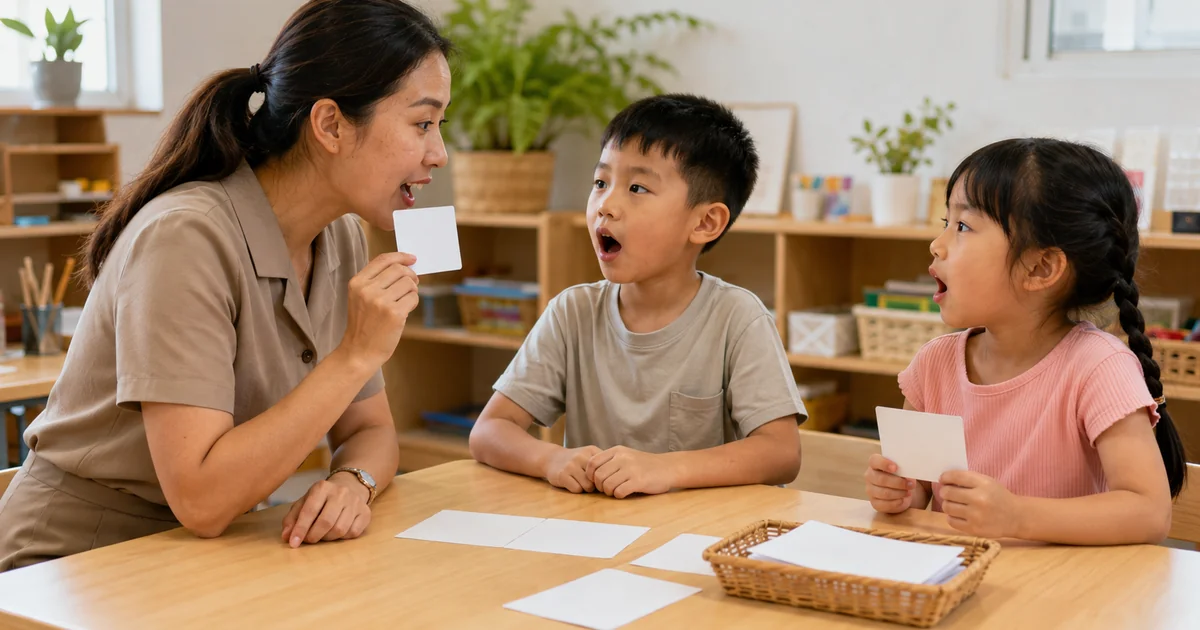



Have you ever, when you're at home, your child seems to know quite a bit of English? Turn on the song and sing along. Asked about the vocabulary, it was enough to answer. Some sentences are heard and understood. But when the teacher actually asked or someone from a foreign country invited them to talk, they were quiet and just smiled. or turning to look at their parents as if signaling “Help me answer.”
If you encounter a situation like this Don't be in a hurry to worry about that. Children do not dare to speak English Because I didn't intend to study. or has already studied and is not effective Children's silence can be caused by many reasons. Some people couldn't listen to the question in time. Some people think of the answer but need time to put it together. Some people are afraid of saying the wrong thing and others will laugh. Or some people are very good at talking at home. But when I'm surrounded by people I'm not familiar with, I want to be a listener first.
You can think of adults learning a second language. Sometimes I know the answer in my head. But when called to speak in front of ten people All knowledge seemed to temporarily disappear. Children can have feelings like that too. Therefore, the goal of practicing English for children does not have to start with “How to get your child to talk as much as possible?” But you should start with How to make your child feel safe enough to try talking?
From a single word to a phrase From phrases to sentences And from responding to familiar people to being able to speak to others more, it all happens gradually at the child's own pace. The approach of Cambridge English for parents and children It points in the same direction. That is, confidence in speaking should be built gradually through repeated opportunities to use language in a non-pressive atmosphere. More than rushing to get it right the first time.
Before starting practice, try to notice where the child is stuck.
If you see your child being quiet when using English The first thing that helps a lot is not to rush to conclusions. “I don't dare speak.”
Try turning into an observer for a moment and see. In what situations does a child not speak English?
“Do you want to stay at home?”
“Can you speak along to the song?”
“Can you answer your parents but not your teachers?”
“If it's a simple question, you can answer it, but when it's a long question, are you quiet?”
“Or actually the activity there isn't something he's interested in at all.”
Once you can tell where it's stuck How to help is very different.
Can't hear in time, can't think of words, or is afraid of being wrong
Children who don't answer English questions may look the same on the outside, “quiet,” but on the inside they may be experiencing a different story.
Let's say the teacher asks, “What did you do last weekend?” The first child may not understand the word weekend and therefore doesn't know what the teacher is asking.
The second child understood the question. I know you went to the zoo. But I'm thinking about how to say “going to the zoo” and should I use go or went?
The third child knew both the question and the answer but thought, “If I say the wrong tense, will my friends laugh?”
The three of them were silent as well. But needing help is not the same at all.
If your child doesn't listen in time You may need to reduce the difficulty of the sentences and increase the vocabulary needed. If you can't think of a word It may help to provide options or starting words. As for if you're afraid of being wrong? The important thing may not be teaching more grammar, but creating experience that “It's okay to say the wrong thing. You can try again.”
So time Children do not dare to speak English Let's also look at the events before and after the silence. It will help to understand more than just looking at whether the child answers or does not answer.
Dare to speak at home but quiet in class.
This is another very common situation. At home, your child might say “I want water” or sing loudly in English. But when I went to class The teacher asks your name. Instead, he looked at the ground and didn't say a word.
If it's like this At least we know that children “have language”, they just haven't used it in certain situations. Reasons may be unfamiliarity with teachers, new friends, and classroom atmosphere. or the feeling that you are being watched
Shy children can learn English. There is no need to wait until you become a child who dares to speak in front of everyone before starting. What helps is to give them time to get to know their environment first. At first, children may participate by pointing at pictures, nodding, choosing answers, following along with gestures, or speaking with the group. As you become more familiar with it, gradually move to answering alone.
Changing from “not speaking at all” to “speaking together with friends” is already a step. There is no need to go straight to the front of the room and speak.
Not interested in the content or activities used
Sometimes the problem isn't the language. But it's about the matter that we invite to talk about.
Ask a child who loves dinosaurs, “What dinosaur do you like?”
May answer in a set But when asked about things that you don't know or aren't interested in, such as hobbies you've never done, It might be quiet.
English activities for children should be connected to things that the child actually has something to say, such as toys, animals, games, food, friends, school, cartoons, or activities that have just been done.
For young children Especially the first period of training. Fun creates reasons for children to want to use language. If every time you speak English you must answer questions from the exercises. Children may also begin to view speaking as being tested.
Parents can try writing down for a week or two, When does your child speak well, when is he quiet? Who is he with and what activities are he doing? Without being labeled as “shy,” “inattentive,” or “not good at languages,” we don't keep score. But I'm looking for the most comfortable way for my child to learn.
Create a space where children dare to try using language.
If you want to build your child's English confidence One thing that helps a lot is making children believe that English is a tool for talking. It's not a test where you have to say every word correctly.
Children need space to try out sentences, stop thinking, change words, and sometimes say the wrong thing and still keep the conversation going.
Reduce correction of every word immediately
Suppose your child says, “Yesterday I went to zoo.” If right after you say, “That's wrong, you have to use went and then you have to use the,” the child might get one grammar point, but the conversation stops right there.
Another way is to receive your child's message first, such as “Oh! You went to the zoo yesterday? What did you see?” The child hears the correct sentence. But I still feel that the listeners are interested in the story he is telling.
That doesn't mean that you shouldn't change the language at all. Solving is still useful. especially recurring errors But it is not necessary to fix everything in every sentence.
Time Children do not dare to speak English An early goal might be to create a flow of speech first. Then choose one or two points to help adjust after that.
Use questions that have multiple answers.
Questions like “What is this?” or “What color is it?” are useful for children who are learning vocabulary. But what if every conversation had just one correct answer? Children may begin to feel that every time they are asked a question, they are taking a test.
Try adding questions that don't have a single answer, such as:
“Which one do you like?”
“What do you think will happen next?”
“Who is your favorite character?”
“If you had a dinosaur, what would you name it?”
Answers can be short or long. And no one said that choosing this dinosaur was “wrong” if the question was still too difficult. It helps with options such as
“Do you think he is happy or scared?” Then add, “Why?”
This method helps children's English speaking practice start with what they can answer. Then gradually expand it out a little bit.
Give children time to think and answer in pairs or small groups.
Adults often cannot tolerate silence for long. I asked for two seconds. The child hasn't answered yet. We have helped in return.
But for children who are listening to a second language He may have to do many things at once. including understanding questions, finding words, arranging sentences, and deciding whether or not to speak. Try giving it a little more time.
In the classroom, a child who is not yet confident might start by speaking with one friend. Then share it with the group. Or practice your answers with the teacher before speaking in front of the class.
Pair → Small Group → Whole Class is a gentler route than calling on children who aren't ready to immediately stand up and answer.
Short practice activities at home
Home can be a very good training space. Because it is a place where children feel safe. But it is not necessary to declare that “It's time to learn English!”
You can insert language into what you're doing, even 5-10 minutes a day regularly, but it's easier to do one more long class.
Playing a role from a nearby situation
Many children are more vocal when they don't feel like they're “answering the question.” Try playing restaurant. By letting your child be an employee Parents are customers
“Can I have some pizza?”
“Here you are.”
“How much is it?”
Or play at the airport, grocery store, animal hospital, school, or ice cream shop based on what your child is interested in.
You don't have to use difficult sentences and you don't have to play for a long time. If any words are stuck, let's think together and continue playing.
Role Play activities give children a reason to speak. Because language becomes part of the game. It is not something that must be memorized correctly before it can be used.
Tell stories from pictures and short books.
Pick up one picture. So you don't have to start with difficult questions.
Try asking, “What can you see?” If your child answers “Dog,” you can say, “Yes! A big dog. What is the dog doing?”
Or open a story and pause before turning the page, asking “What happens next?” Young children may be able to answer in one word. Older children may try to form sentences. There is no need for every word to be grammar correct.
Another game is take turns telling a story. Parents say one sentence One more sentence It can be as funny as it gets. The more the story is out of this world. Sometimes the child wants to talk more.
Record audio to listen to your progress.
Some children don't like talking in front of others. But it's fun to record.
Try choosing a short topic like “My favorite animal” and speaking for 20-30 seconds. Don't send it to anyone.
Save it and try a similar topic again after a while. The child may hear that In the past, I often stopped and thought. But now he talks more continuously. or start using longer sentences
The clip should not be used to detect how many words are mispronounced. But use it like a voice recorder. “We have been able to do more.”
If you want additional activities You can read more at How to help your child practice English at home
Choose a learning format that suits the child's confidence.
when Children do not dare to speak English Some parents may immediately think, “Then you have to study one-on-one,” while some people think “You have to join the group. You will learn to integrate into society.”
Actually, both types have different roles. And you should look at your child's behavior.
What are the different roles for small groups and one-on-ones?
Small groups give children the opportunity to listen to their friends. Talk to many people, play games, and see that other people also make mistakes or stop thinking. Some people feel more comfortable when they're not the only ones being asked.
At the same time, some children may still not dare to vote in the group. One-on-one lessons allow teachers to adjust the pace, give them time to think, and choose topics more carefully based on the child's interests.
There is no answer that one-on-one is better than a group. Or is a group always better than an individual?
Try asking: When you're with one or two people, does your child talk more? Does he gain strength from being with his friends or does he feel more anxious? And how much do you want to fix specific issues such as vocabulary or pronunciation?
See more comparisons at Group or one-on-one English classes for children
When should you talk to your teacher or institution?
If your child has been studying for a while but is still quiet in class. Don't rush to the conclusion that the course is not suitable. Try talking to the teacher first. Because parents see their children in the house Teachers see another side of the classroom.
These two pictures taken together may make the cause much clearer.
Ask for information that can help you plan further.
Instead of just asking, “How was your child's school today?” Try asking more specifically, for example:
“Do you understand the instructions in class?”
“Time is a dual activity. Do you talk more than when answering in front of the class?”
“Is there a topic that your child is especially interested in?”
“When you don't answer, it's because you don't understand the question or you need to take time to think.”
“Now what does the teacher want me to continue practicing at home?”
“Is the activity level too difficult or too easy?”
This information helps parents and teachers plan in the same direction.
If the child talks a lot at home But in class, we still haven't spoken at all. You should also tell the teacher. Because this is important information, language background may not be the main obstacle.
On the other hand, if both at home and in class the child often cannot think of words. You may need to reinforce Vocabulary or practice basic sentences before increasing the difficulty of Conversation.
Frequently asked questions
Should I force my child to speak English every day?
There is no need to force them to speak every day with a set number of words or sentences. Because it may cause children to begin to associate English with pressure.
What you can do is add “opportunities” to use language more often, such as inviting children to pick fruits in English, singing songs, playing games, or asking simple questions and letting the child choose an answer.
Some days my child talks a lot. Some days I want to listen more, and that's okay.
The goal of building confidence in English is to make children want to use the language again. It's not like making a total of how many sentences you've spoken today.
Should a child's pronunciation be corrected immediately?
There is no need to fix it every time. If the wrong words cause the communication to be incomprehensible Or is it a wrong sound that is repeated often? can help solve it But choose the right moment.
Sometimes just saying the correct picture naturally is enough. For example, your child misspelled a word. Parents respond by using the correct form of the word and continue the conversation.
If it is a special period of pronunciation practice You can gradually stop and look at the mouth position or practice again.
English speaking practice for children must build both accuracy and courage. There is no need to choose one or the other. But you should know what time you are practicing what.
If the child hasn't spoken yet Should I change courses immediately?
Not necessary yet
Before changing, try to see if your child understands the lesson. Are there other forms of participation, such as listening, doing activities, pointing, answering in short words, or speaking when working in pairs? Also, try talking with teachers about how their behavior has changed since starting school.
If the activity is too difficult Children do not understand the content Or the classroom format prevents the opportunity to actually speak. Adjusting the level or format may help.
But what if children just need time to get used to it? Switching classes too quickly may mean having to adjust to your surroundings again.
time Children do not dare to speak English Therefore, you should look at the basics, feelings, and behavior in the room. and opinions of teachers together Don't use silence alone as the deciding factor.
If you want to look at the overall picture, what kind of curriculum should your child's age, background, and goals be connected to? You can read more at How to choose an English course for children based on their age
Finally, I would like to invite parents to change the question from
“How can I get my child to speak now?” to “What can I do next time?” Do you dare to speak a little more?”
A little more and it might be a one-word answer to two words. From speaking with friends It's a one-sentence answer. or from having given to your parents in return Today try answering it yourself.
These small steps are progress.
If you are looking for a learning format that gives your child the opportunity to gradually use English on a basic basis, you can see ecc's English course for children and talk with the ECC team about age, background, personality, and what you want your child to develop. to help each other look for an ideal starting point
Because the goal isn't to make the most kids talk in the room. But it is to help him gradually feel that “English is something we can try. It's still not perfect, but that's okay.”