


“Do I have to review it with my child every day after returning from school?”
“We ourselves are not good at English. Is it wrong to teach your child?”
“Every time I open a book Your child acts like he has more homework…”
If you've ever felt like this Don't worry about having to transform yourself into a home English teacher because Practice children's English at home It doesn't always have to mean opening a book, doing a worksheet, or setting aside an hour to study.
For children, especially young children What is very helpful is encountering English frequently in understandable situations, such as eating, getting dressed, playing with toys, reading a story, or riding the car to school. Some days there might be only 5 minutes of English, some days there might be one song. And then that's the end of it. What is more important than length is Do it and feel comfortable. You can repeat it and it doesn't make the child think that English is just another pile of homework.
Parents therefore do not need to “teach in place of teachers” but can help create a space for their children to listen, try to use, and feel that English can be used in real life as well. Cambridge English for parents and children also recommended a similar approach That is, allow parents to help create opportunities to use language in everyday life. rather than having to act as a content teacher yourself
Principles to think about before starting to practice English with your child at home
Before looking for activities or buying additional books Try setting three simple principles first. Because if the initial way of thinking is not pressured It will be much easier for both parents and children to continue.
Choose small, repeatable goals.
Some homes start with a very big goal, such as “This month I have to memorize 100 words.” But for Practice children's English at home Actual small goals are often more achievable.
For example, this week try using food-related words when eating. Or choose just a few short sentences to use every day.
“Are you hungry?”
“Do you want some milk?”
“Let’s eat!”
Your child may not respond in English right away, and that's okay. He's just heard the same sentence in the same situation many times. He was slowly connecting the sound with the meaning.
When these words became familiar Gradually add new words or sentences. This method may seem slower than opening a flashcard with dozens of words at a time. But it helps the language have more meaning in real life.
Use language in a context that children are familiar with.
If you want Practice English with your child Let's start with things he already knows.
“When dressing, talk about colors.”
“When playing with cars, talk about fast and slow.”
“When eating, talk about food.”
“When putting away toys, use simple commands.”
“Before going to bed, talk about what happened today.”
Because children don't have to think either. “Things to say” and “English” together
Suppose your child is holding a banana. We don't need to pick up a flashcard and ask, “What is a banana in English?”
Simply say, “Banana! Do you want a banana?” The meaning is right in front of you. It's easier for kids to guess.
This is the advantage of using language in a real context. We don't just teach vocabulary. But it is showing when this word is used.
Give encouragement rather than checking for every word wrong.
Imagine every time we speak a new language. Someone kept stopping and saying
“wrong”
“New pronunciation”
“Grammar is not correct.”
No matter how determined you are to study, After a while, he probably didn't want to talk.
It's the same with children. If you say, “I went to school.” Instead of stopping and saying, “No, you have to say went,” every time, try to pick up on what your child is trying to say. “Oh, you went to school!” Your child will hear the correct sentence. And the conversation can continue.
That doesn't mean it's forbidden to fix it at all. But it is not necessary to correct every point in every sentence. Especially when the goal is to make children dare to speak.
Sometimes a simple compliment like “You can tell me more” or “I thought of that word today” can help build a desire to use language more than counting how many words you've said incorrectly.
Short activities for children of different ages
English activities for children do not have to be the same for all ages. Young children may learn by listening and moving. Elementary school children can start playing with words, reading stories, and creating more conversations.
Choose from things that your child is interested in and can do first. Then gradually increase the level according to development.
Young Children: Pictures, Songs, and Routine Instructions
For homes that are starting to learn English for young children. You can try using music as a help first. There is no need to play new songs every day. Choose one or two songs your child likes and listen to them over and over. The fact that children can sing certain words Or start doing a pose before a familiar part. It means he is memorizing language patterns.
Pictures and real things work well. Try picking up three toys and saying,
“Where is the car?”
“Can you find the bear?”
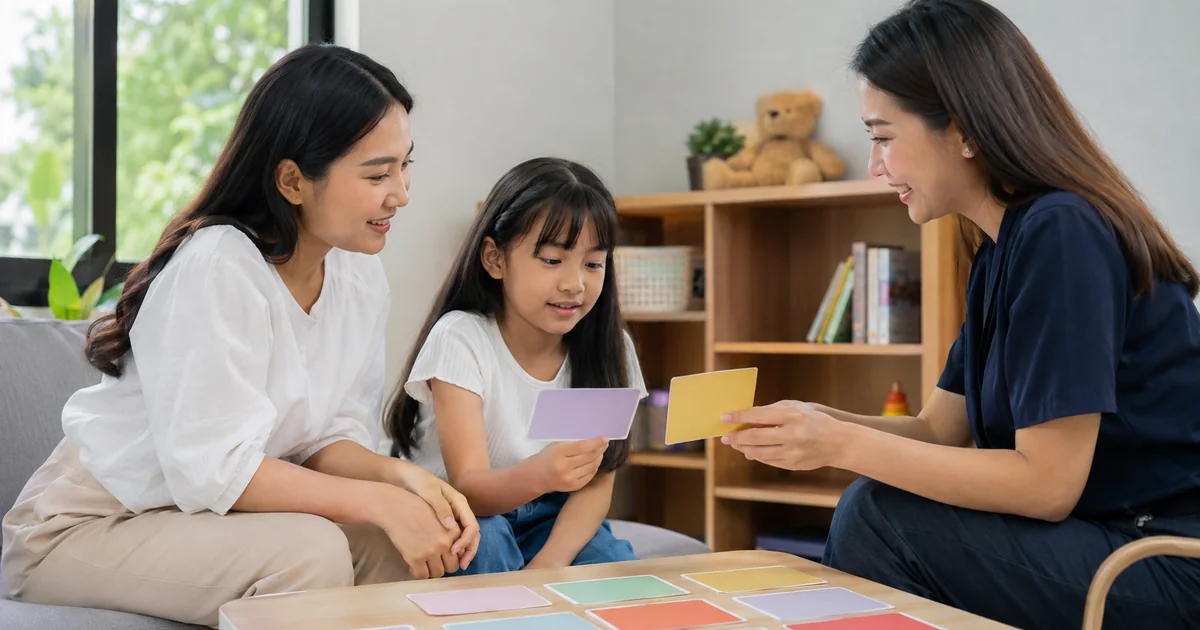
Children do not need to answer in sentences. Just picking up the right item is considered to be understood. Another way is to use simple commands in your routine, such as:
“Put on your shoes.”
“Wash your hands.”
“Open the door.”
“Let’s go.”
These words are followed immediately, so children gradually understand them without having to memorize the translation.
Elementary school children: Vocabulary games, short stories, and easy conversations.
For English for elementary school children We can add small challenges, such as the game “Find 5 things” while walking in the supermarket.
“Find something red.”
“Find something cold.”
“Find three fruits.”
Or play a vocabulary game. Set a timer for 30 seconds and take turns saying the name of an animal, food, sport, or household item. Whoever can't think of it first ends the round.
Another activity is “Questions of the day” don't have to ask a lot. Just one thing per day is enough, for example:
“What was the best thing today?”
“What did you eat for lunch?”
“Who did you play with?”
The first part can be answered briefly. Parents can help with another question and then the end. There is no need to change to Conversation Class every dinner.
action Practice children's English at home This helps the things learned to be put into practice. These activities are also a good addition to homes that are considering additional courses. If you want to see what skills an English course for elementary school children should focus on next. can read at How should elementary school students choose an English course?
Children beginning to read: Short books, signs, and storytelling.
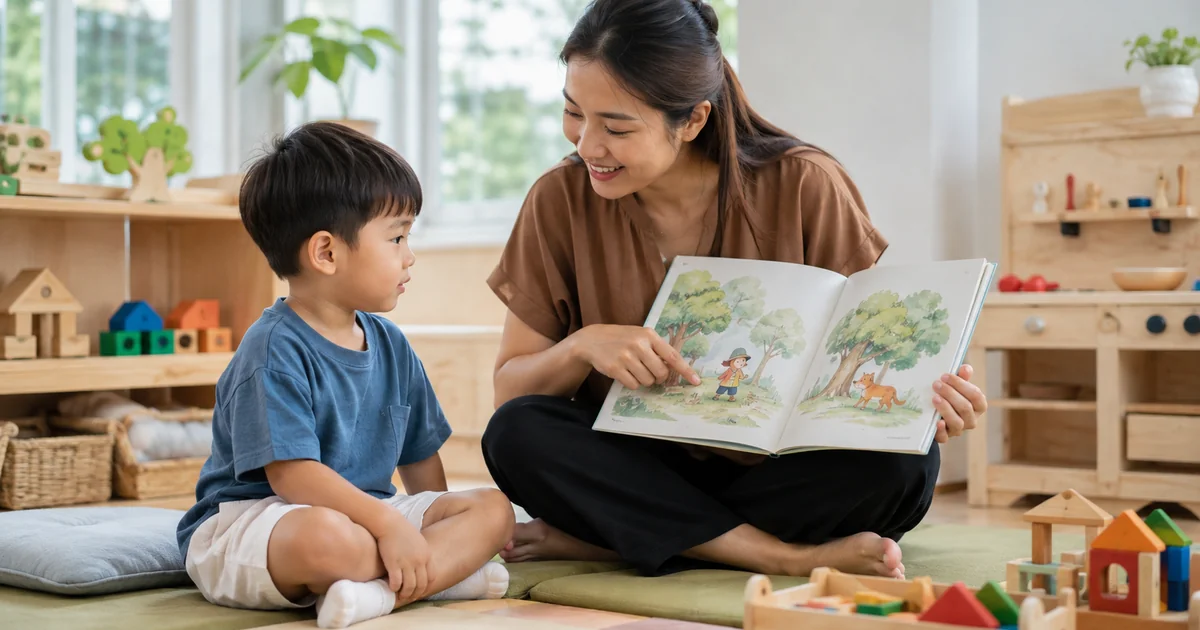
If your child has started reading English There is no need to hurry and buy a thick book. It's better to choose a short story that you can understand for the most part. Because children will have energy left for enjoying the story. You don't have to spend all your time unpacking every word. Read together and try asking simple questions such as:
“Who is this?”
“Where are they going?”
“What happens next?”
Or let your child choose a page they like and tell it in their own words. No need to memorize sentences from books
besides books You can read things around you: store signs, food menus, cereal boxes, product names, or words on toys. These are real English texts that children encounter in their daily lives.
When I saw the words I had learned on the real thing Children will begin to feel, “Oh, this word isn't just in textbooks.”
Create opportunities to speak without scaring your child.
One thing that parents often worry about is “they understand everything but they don't want to say it.” This is even more urgent. Sometimes children are quieter. Instead of aiming to speak every day Try creating a situation where I want to talk. more first
Use open-ended questions that can be answered in multiple ways.
If every question has one answer, e.g.
“What color is this?”
“What is this?”
“How many apples?”
Children may begin to feel that their parents are checking their knowledge.
Questions like this can be used. But try alternating with questions that don't have a right or wrong answer, such as:
“Which one do you like?”
“Who is your favorite character?”
“What do you want to eat?”
“What do you think happens next?”
Your child will have more room to speak their minds. If it's still difficult, giving them options can help, such as “Do you want pizza or noodles?” When you answer, expand to “Why?” and this will start a conversation.
Play roles from everyday life
Role Play is one of the English activities for children that is very easy to do. because they use things that are already in the house
“Play the ice cream shop. The child is the seller.”
“Play the restaurant. Let parents be customers”
“Play animal hospital with dolls”
or “playing the airport with a small suitcase”
There is no need to prepare a full page of script. Start with a simple sentence such as:
“What would you like?”
“I want chocolate.”
“Here you are.”
“Thank you.”
Children tend to speak more when language becomes part of the game. Instead of feeling like you're being called upon to answer questions in English
Give the child time to think before helping.
When I ask a question, my child is quiet. Many parents can't help but rush to give back. “Don't you remember? Apple,” but the child might actually be thinking about it. Try waiting a little longer. Or just help with the first word, such as “I like…” and let your child add it themselves.
If you still can't figure it out, give yourself an option. A small break in time lets the child know that he has the opportunity to think and answer on his own. There's no need to compete with your parents to see who can think of a word first.
If your child understands English but still doesn't dare to speak it. You can read more at Ways to help children become more confident speaking English To see if the cause may be from confidence, background, or the situation in which the language is used.
Connect training at home with what is learned in the course.
If your child is already studying a course The house does not need to create another set of courses. The easiest is Pick up what you are learning and continue playing. Children will encounter the same language again in a new context. And parents don't have to guess what to teach next.
Ask the teacher about the vocabulary or topic being studied.
Try asking your child or teacher what they are learning these days.
“If you study Animals this week, at home you might try guessing animal sounds.”
“If you study Daily Routine, try using English when you wake up or before going to bed.”
“If you are learning about Food, try having your child help you choose a menu and say the name of the food.”
action Practice English with your child So it becomes a review that doesn't feel like you're reviewing. Not sure what you should practice? You can directly ask the teacher, “During this time, are there any words or sentences that you can use to continue playing at home?”
Small questions like this help connect what's going on in the classroom with what's happening at home.
Do not push the content beyond the level of the child.
Sometimes when I see my child starting to do it. Parents want to help you go faster.
Learn 10 vocabulary words and add another 20 words to read short sentences. He immediately picked up the long book.
But language development does not have to be in a hurry to add new things all the time. Being able to use the same thing multiple times is very helpful.
One word that children can listen to, understand, speak for themselves, read and know. and can be used in sentences It's more valuable than knowing the meaning of many words but not being able to use them.
When practicing English for children at home, it is not necessary to always lead the course. Walking beside each other is enough.
Things to avoid
Parents have good intentions. But some methods may cause children to feel pressured without us noticing.
Make every moment a test
When he saw milk he asked, “What does milk mean?”
Saw a dog and asked, “How do you spell Dog?”
Saw red and asked. “What color is this in English?”
If it happens all the time Children may become suspicious of their parents when there is a Quiz hidden there.
Sometimes it's okay to just speak the language without asking.
“Oh, a big dog!”
“Your shirt is red today.”
Children hear the same language. But you don't have to be in correct answer mode.
Compare with siblings or friends
“At this age you can already speak,” or “My friends in class can answer. Why don't you speak?”
Sentences like this may be intended to be stimulating. But children may hear “We are not as good as others.”
Each child has a different rhythm. Some people speak before reading. Some people are good at reading but take a long time to dare to speak. Instead, try comparing your child to his past self. For example, “In the past, this word required my mother's help. Now you can remember.” Small progress like this is tangible and truly belongs to a child.
The media is too difficult to use and children lose interest.
Not all English cartoons are suitable for children just because they are in English.
If the content is fast, the vocabulary is difficult, and the child doesn't understand what's going on. He can look at the picture. But it doesn't engage much with language. Or in the end, you may lose interest altogether.
Choose media that children can understand in general. And it's better to have a slight increase in difficulty from the current level. If you watch it and laugh, you can guess the story and start to catch some words. That's often a good place to build on.
Frequently asked questions
Can parents who are not good at English help their children?
Yes, and you don't have to be fluent in English before you can help your child.
The role of parents is not to replace teachers. But it is to help create opportunities for children to encounter language regularly. can turn on music Read books together Play word games Or ask the teacher what your child is studying these days. Then please review only that.
If you are unsure about pronunciation There's no need to guess. Use reliable audio media. Then you can study together with your child.
Sometimes saying “I still don't know this word. We'll find it together.” It also helps children know that Not knowing is not shameful.
How many minutes per day should you practice?
There is no single number that works for every child.
Young children may acquire English from many short sessions, such as a 3-minute morning song, instructions for getting dressed. and bedtime stories
Primary school children may have more continuous activities, such as reading a story or playing a game for about 10-15 minutes. If it's still fun, they can continue.
What you should see is After doing the activity, does your child still want to come back and do it again? There is no need to stop at the specified minute. And there is no need to stretch for the full time if the child is already tired. For practicing children's English at home. Do it for a short time but come back and do it over and over. It is often more suitable for the real life of a family than setting a goal so hard that it can only be achieved for a few days.
Do I have to correct my child's pronunciation every time?
“Not necessary” if it is a sound that changes the meaning Or the child makes the same mistake again and again until it becomes a habit. You can choose the moment to help solve it.
But if you're telling a fun story and your pronunciation is slightly incorrect, There is no need to stop the conversation every time.
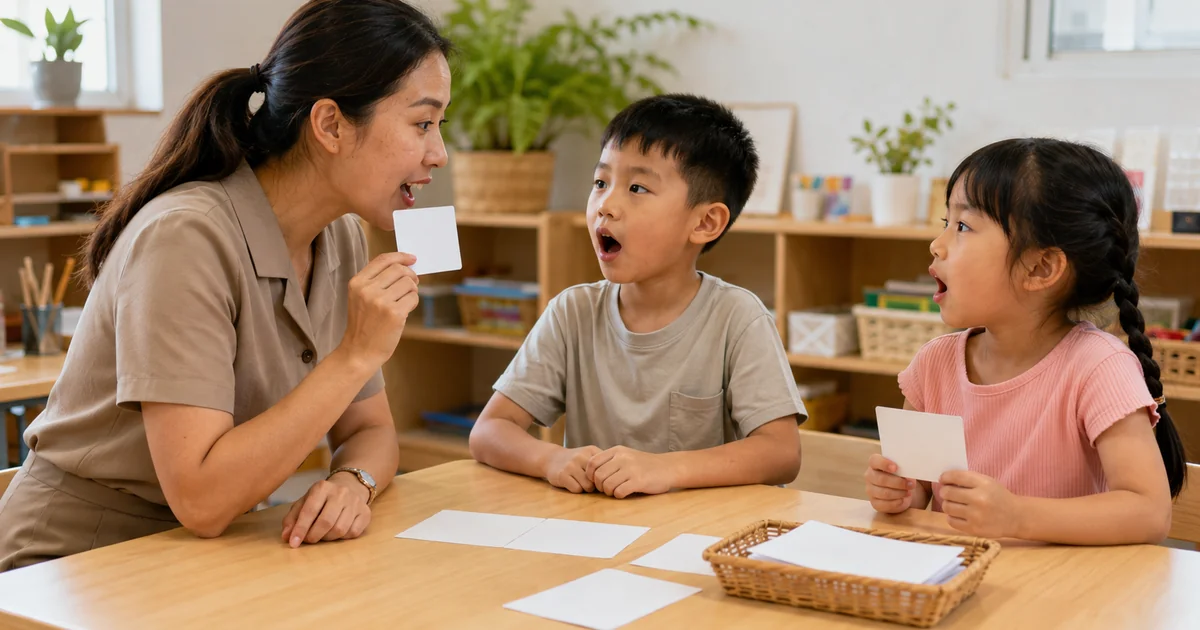
An easy way is to say the word back correctly and then continue talking. For example, your child mispronounces a word. Parents may respond by using the word in the sentence again. The child will hear the correct picture without feeling criticized.
Ultimately, practicing children's English at home does not require adding one more subject to their schedule.
Try starting with the small things you already have.
“One song in the car”
“One question while eating”
“One game while collecting toys.”
“One short story before bedtime”
Some days I can do a lot. Some days I barely use English, and that's okay.
What we are creating is not a statistic about how many minutes your child studies per day. But it's the feeling that English is something you can use without fear of being wrong.
If you want to see how training at home should be connected to studying, you can read: How to choose an English course for children based on their age To see the basics, goals, and learning guidelines for children of each age group.
And if you are looking for a course for further development can see details ecc's English course for children Along with asking the ECC team about your child's age, background, and what they are studying. To help plan the way at home and in class to go together.
Because for children The best person to help with language at home You don't have to be the best English speaker. But it is someone who makes children feel that “You can try to speak, you can make mistakes, then we will learn together.”