


“My child is only 3-4 years old, is it too early to start learning English?”
It's a question that many parents think about as well. Especially when seeing children the same age start singing English songs. speak in sentences Or have started studying Phonics and can't help but wonder: Should our children start? If you haven't started yet, will you not be able to keep up with others?
Actually, the Learning English for kindergarten children There is no need to rush to read fluently, write well, or speak in long sentences from the beginning.
What is more important is Have children encountered English in a format that is appropriate for their age?
For young children Language can come in the form of songs, stories, games, movement, colorful pictures, or simple everyday words such as Hello, Thank you, Sit down, Let's go, or words about colors, animals, food, and toys.
If children listen and are interested Can join the activity and began to feel that English was fun That is a very good starting point.
So instead of asking, “How much education do I have to study at this age?” try changing it to “What kind of English experience should I have at this age?” will help make choosing a kindergarten English course much easier and more comfortable.
Targets suitable for starting English in kindergarten
Kindergarten children are still in the stage of learning about the world through playing, listening, imitating, and doing. The goal of language learning should therefore move in the same direction.
Success is not necessarily measured by the number of words remembered. Or ask every week: “How many sentences can you say after studying?”
Instead, let's look at the small developments along the way.
Familiar with everyday sounds, words, and meanings
At first, the child may not speak much English but is gradually picking up the sounds in his head.
For example, hearing the teacher say “Stand up” and getting up, or hearing “Show me the red one” and being able to choose a red thing.
Children may not be able to explain what these words mean yet. But you can begin to connect the sound with the meaning.
Learning English for kindergarteners does not require translating every word into Thai. Children can learn from images, actions, tones and situations.
Think about when you were a child learning your mother tongue. We didn't hand him a flashcard from birth. But by repeating the same words in the same situation over and over until the child understands, English can start in a similar way.
Enjoy listening, speaking, and participating in activities.
For young children, the word “fun” does not mean that learning is not meaningful.
On the contrary, fun makes children want to come back to the same language over and over without feeling like they are being forced to memorize it.
One song can give a child a whole vocabulary. Pronunciation rhythm and short sentences, one game may require listening to instructions then respond with speech or movement
English activities for children that are appropriate for their age should therefore provide opportunities for children to do more than just sit and listen.
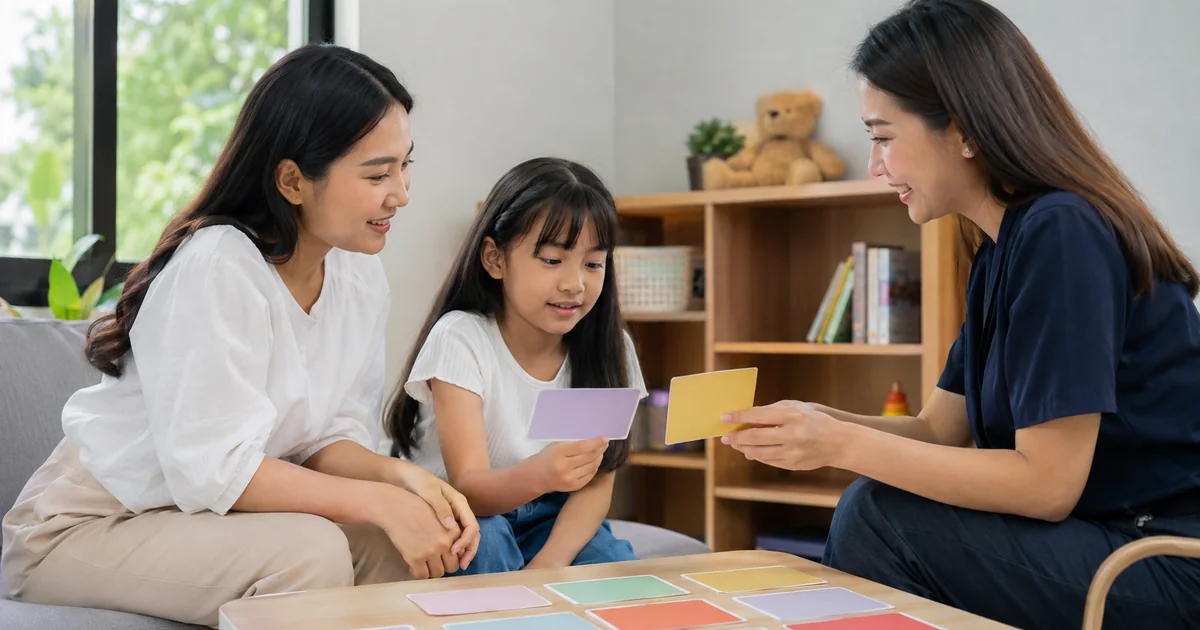
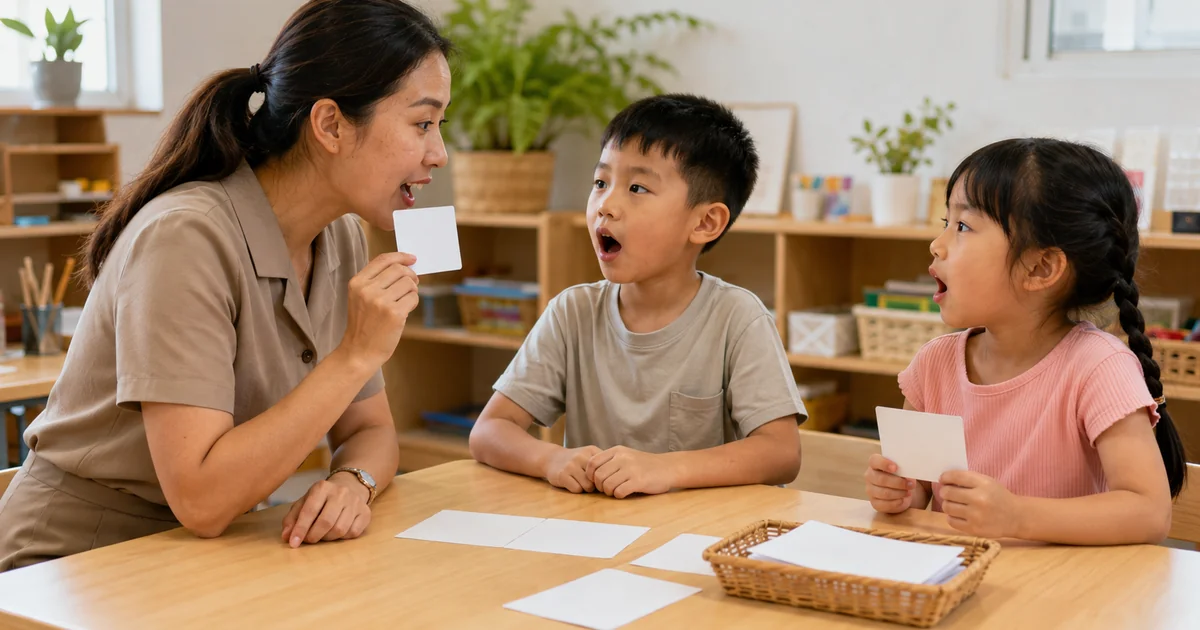
Children may sing along, speak along, point out pictures, pick up objects, run to find the color that the teacher tells them. or play a short role-play
If you come home and your child picks up words from class and uses them himself. Or request to play the same song again That's a good sign that he's building a positive relationship with language.
Build confidence in trying the language
Kindergarten children do not yet need to say every word correctly.
If your child can only say one word, such as “Dog!”, instead of responding in full sentences, It is considered that he is trying to use language.
Adults can help extend the sentence without making the child feel guilty, for example:
“Yes! It’s a big dog.”
Children will hear more sentences. and also feel that their own answers have been listened to
The goal in the first period should be to make children dare to try. It is not to make children afraid that they must think correctly before they can speak.
If children learn from the beginning that You can say the wrong thing and try again. English is more likely to become an area that he dares to use as he gets older.
Characteristics of activities suitable for young children
When parents look at details of the kindergarten English course Don't just look at what the subject is taught, look at how the child will learn it.“
The same subject can be taught in many different ways.
Animal vocabulary may be taught by having children memorize word lists. Or it can be changed to a game of guessing animal sounds, stories, or physical activities.
For young children The way it is presented has a huge impact on the learning experience.
Songs, stories, pictures and movement
Preschoolers often respond to things they see, hear, and do.
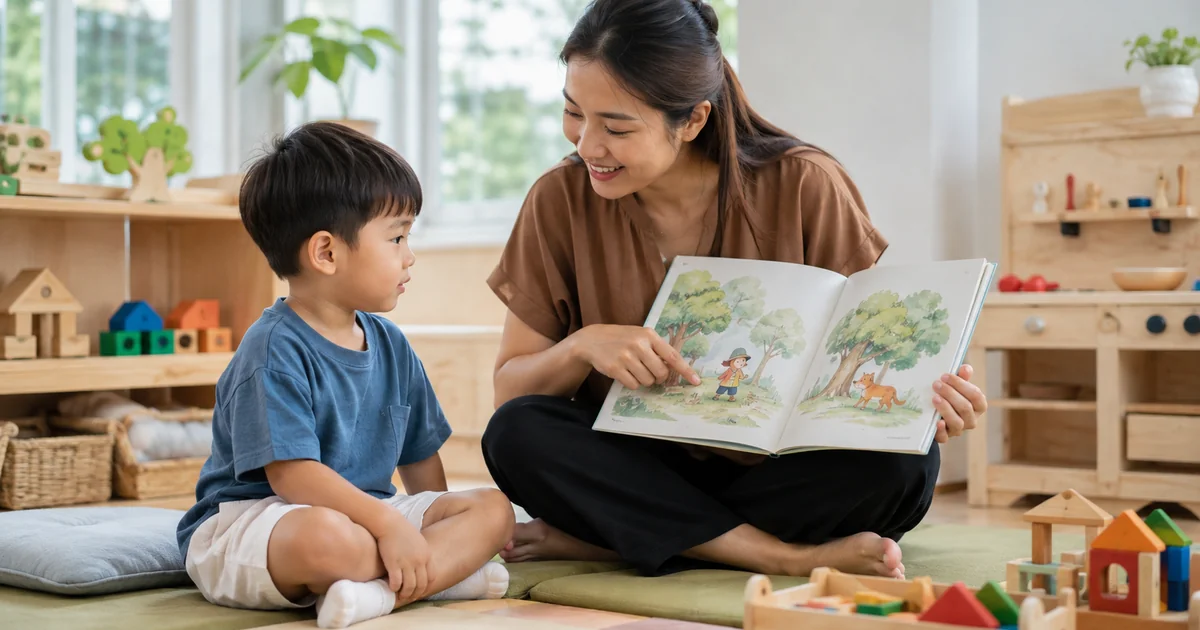
Songs help you hear the same words repeated in an easy-to-remember rhythm. Stories help children guess the meaning from pictures and stories. The movement part helps keep the vocabulary from floating around just in the book.
For example, learn the word jump and actually jump.
Learn the word happy and make a happy face.
Learn the word elephant and pretend to be an elephant.
These activities connect language to direct experience.
Therefore, when choosing English for children 3-6 years old, you should look at how much space the class gives the child to speak, play, listen, and move. You don't need to have a lot of worksheets to be considered learning.
meaningful repetition
Parents may have wondered. “Why does the teacher play the same song again?” or “Why do I learn the same words so many times?”
For young children Repetition is very common. And it helps what you hear become familiar.
But repetition doesn't have to mean sitting and saying cat, cat, cat ten times.
The word cat might come back in the song one time. In the story again and appears in the game “Find the cat” again
The child has encountered the same word. But in different situations Therefore, understanding is more than just memorizing sounds.
When considering learning English for kindergarten children Try to see if the curriculum reuses what has already been learned. Because children don't just want “Learn a lot of new words,” but you must have the opportunity to use the same things until they start to become your own.
The time is short and the pace at which the child can keep up.
Young children are not designed to sit still and listen to one format for long periods of time.
If one class has to study many subjects. Activities should be divided into short periods with alternating rhythms, such as listening to music followed by games, sitting and looking at pictures, and then getting up and moving.
When the activity changes before the child loses interest Children have an easier time refocusing on language.
This is therefore more important than simply asking, “How many minutes per period?”
Also try asking: During that lesson, what must the children do? And how do teachers adjust activities when children become distracted? Cambridge English Starters This is the first step in the Young Learners framework from Cambridge. It is designed to be short. It is a fun activity that is similar to the attention span of young children.
What role does Phonics play at this age?
Another word that parents of kindergarteners often hear is “Phonics”.”
Some houses are worried that if they don't start early, their children will be slow to read, while others are afraid that if they start early it will be too difficult for their age.
Phonics is actually useful, but it doesn't have to be the only answer to learning English for kindergarteners.
Explain the beginning of sound without making Phonics the only answer.
Phonics helps children understand the relationship between sounds and letters, such as how a letter or group of letters connects to a sound. And how are those sounds mixed into words?
For young children with Phonics, the starting point may not be reading a lot of words.
Children can start by listening and separating sounds, playing sound games, singing songs about letters. Or notice how the first sound of different words is similar or different.
When children are more ready, they can then connect sounds with letters and word combinations. It's important not to let Phonics take up all the listening, speaking, vocabulary, and fun space. Because there is more to English than just transliteration.
Children also need to know what the words they read mean. And how can it be used to communicate?
If you want to see a clearer picture of how Phonics is different from the 4 Skills and Conversation, you can read more at How are Phonics, 4 Skills, and Conversation different for children?
Signs that parents should watch out for during class
When I started studying There's no need to ask every week. “Are you better yet?” Try observing small behaviors first, because for kindergarten-age children Language development is not always expressed in scores.
Attention, response, and comfort
After starting to study English in kindergarten Let's see how the child feels about the class.
“Before going to school, were you against it a lot?”
“When you see the teacher, do you start to relax?”
“Can you sing or act along?”
“Have you started answering simple words or following along?”
“Do you want to come home and talk about class activities?”
It is not necessary for all of the above to occur.
Some children are verbal. Tell me anything you see. Some children keep information silent and then one day they suddenly say words that we don't know when they learned them.
If your child is still interested and gradually becomes more involved. That's a sign worth keeping an eye on.
But if it continues, the child will still be very stressed. Don't understand most of the activities or unable to participate at all You should talk with your teacher to see if the content or format is too difficult.
Continuity at home without increasing the burden
Once you have applied for the course Some homes may feel like they have to come back and review it every day. Otherwise it won't be worth it.
There's really no need to turn the house into a second classroom. If you study vocabulary about fruits today When you go home, you might say “Apple or banana?” when choosing a snack.
If your child has a song that he has learned Listen on repeat in the car Or sing while taking a shower. Small things like this help children find language again without feeling like they have homework.
Young children learn English well when the language flows naturally into their daily lives. Rather than only having time to sit and study. If you want a more systematic approach to training at home You can read more at How can parents help their children practice English at home?
Questions to ask before choosing a course
When looking at the kindergarten English course Don't be afraid to ask for details. Because the name of the course alone may not tell what children will actually encounter.
How to assess readiness and adjust activities
Try asking: Before starting school, how are children's basics or readiness looked at?
Use only the age to divide the room. Or see if your child listens, speaks, and knows letters. And how much experience have you had in English before?
Another important question is If the children in the room have different rhythms How do teachers adjust activities?
Some people may be ready to speak. While some people still answer in one word. If the teacher can help both people participate on their own level. Children will not find it too easy or too difficult.
Communication between teachers and parents
For young children Parents may not see everything that happens in the classroom. Communication with teachers is therefore very useful.
Try asking: How will parents know what to study during this period? And to what extent do children participate?
If your child doesn't speak in class What do teachers think is the cause?
If your child is interested in a particular subject Can this information be used to help expand?
What are some easy things you can do at home?
The goal isn't to ask for detailed reports every day. But there should be enough information for the home and classroom to help each other in the same direction.
Details that must be checked with ECC directly.
Details such as class schedule, class format, tuition fees, fields of study offered. Application conditions or courses open during each period can be changed
Before making a decision, you should ask ECC directly again. to confirm the latest information and see what options are suitable for your child's age, background, and schedule.
Frequently asked questions
Do kindergarten children have to memorize vocabulary?
There is no need for surfing to be the primary method. Children can remember words from songs, stories, games, pictures, and using the same words in different situations. For example, instead of memorizing the names of colors word by word, they might play a game of finding “something blue” in the room or choosing a color they like.
When words make sense to what the child is doing Children often remember easily and understand where words are used. Reviews are also useful. It just doesn't have to be done in a testing fashion all the time.
If the child refuses to speak Should I stop studying?
There's no need to stop in a hurry. Let's try to see why the child isn't talking.
Some people are still not familiar with teachers. Some people are listening and collecting information. Some people understand but don't like speaking in front of a group. Or some people may feel that the content is too difficult.
If your child can still participate in activities, point out pictures, follow along, or listen to commands. It shows that he may be learning even though he doesn't speak much. Try talking to your teacher and giving them time to adjust first.
But if the child is stressed from continuous classes I don't understand what I'm doing. Or start resisting every time You should come back and see if the level and study style are suitable for him or not.
Should I start studying at home first?
You can start and there is no need to wait to apply for a course first.
At home, you can start with songs, stories, simple vocabulary, or sentences used in daily routines, such as
“Let’s go.”
“Wash your hands.”
“Good night.”
“Where is your bag?”
There is no need to set an official class time.
If children become interested in language Enjoy the activity and the family wants to increase the opportunity to study more systematically So you can consider the course.
If you still want to see an overview of what children of each age should start with. You can read more at How to choose an English course for children based on their age
Ultimately, learning English for kindergarteners doesn't have to be a competition to see who can read first. Or who can speak more?
Try looking at goals that are closer than that.
Children listen to English and are not afraid.
Enjoy the songs and activities.
Start to understand simple words
Dare to try speaking even if the sentence is not complete.
and still want to come back to study again
If you get these things It is considered that we are already building a good foundation.
If you're looking for a starting point can see details ecc's English course for children And talk with the ECC team to help look at the age, background, and activity style that is suitable for your child before making a decision.
Because at this age The important thing may not be to study as quickly as possible. But it is to make children begin to feel that English is another fun thing that he wants to play and learn by himself.