


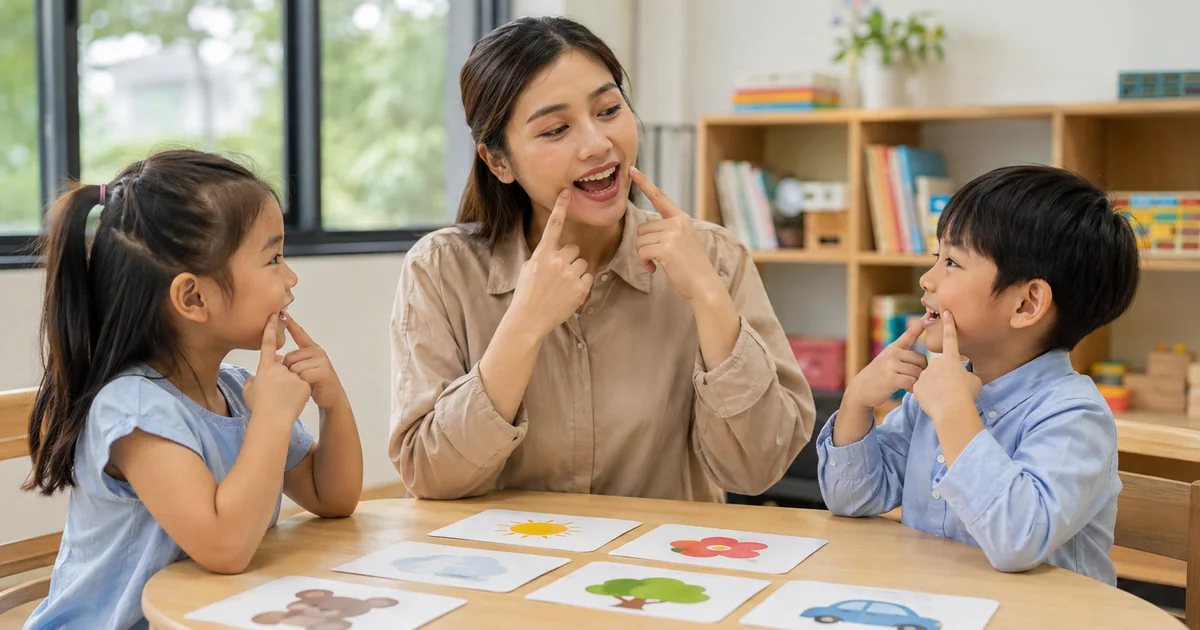
“Is a 4-year-old child starting to learn Chinese too early?”
“If you wait until elementary school Is it too late?”
“You have to memorize Pinyin first. Or start with Chinese characters?”
Question about At what age do children start learning Chinese? It is one of the things that parents ask very often. And the answer may be more comfortable than you think, because it really is. There is no one age that suits all children.
Children of the same age may have different readiness. One enjoys the song and immediately imitates the new sound. Another person needs time to get familiar with the teacher and the place first. Some people like group activities. While the other person is more involved when doing one thing at a time.
Therefore, the Learn Chinese for children You shouldn't start with the question: “What do I have to study at this age?” alone, but you should look at What types of activities are appropriate for the child's development, interests, and learning pace during that period?
For young children A starting point might be just listening to a voice, singing a song, looking at a picture, and repeating simple words.
As he grows up, gradually increase vocabulary, sentences, Pinyin, reading, and writing as he/she is ready.
This article is therefore not used to determine whether a child is “ready” or “not ready”, but it will help parents have a point of observation and choose a starting point that does not put too much pressure on their child.
Age is not the only criterion. Let's look at readiness together as well.
Time to find Chinese language course for children We often see class divisions based on age. which is useful Because children of different ages have different learning methods and attention spans.
But age numbers shouldn't be the whole answer.
Each child is not equally prepared.
Think of two children who are also 6 years old.
The first person heard the new song and immediately sang along. Likes to imitate strange words and enjoys playing in groups.
Another person may prefer to listen first, not be in a hurry to speak, and need time to get used to a new activity.
This doesn't mean that the first person is “better” or the second person is “slower,” just that the styles that help engage the two children may be different.
Time Learn Chinese for children Parents should therefore consider many things together, such as the time period that their child can spend with an activity. Attention to new sounds Response to teacher Including being comfortable when studying with friends.
Children who haven't followed along the first time doesn't mean they're not interested. Some people are in the listening and observing phase first. Then gradually begin to participate as you become more familiar with it.
Signs that parents can notice
No need to do a big test. You can try looking at it from everyday life.
“Do you have fun listening to songs in other languages?”
“Do you like to imitate sounds or words you hear?”
“Can I sit and do a short activity with an adult?”
“What kind of pictures, stories, games, or role playing are you interested in?”
These signals help inform how we should design our starting point. But there is no condition that “You have to be able to do this before you can study.”
Readiness can be developed gradually through tailored experiences for the child. If your child still doesn't like to follow along. You may start by listening to music and pointing out pictures. If you still can't sit with the exercises for a long time. There is no need to rush to select letters in pages.
Sometimes the start is just right. is to bring Chinese language into life in a way that children still feel is “fun”
How to start at each age
Although age is not the only criterion But age also makes it easier for us to organize our activities.
Try looking at it as a broad guideline rather than a fixed rule.
Kindergarten age
for Mandarin for young children The beginning should have sound and meaning before a long explanation.
Children may learn through songs, picture cards, stories, simple games, and moving their bodies. or orders that can be followed
For example, the teacher says words about colors. Then let the child choose that color, learn numbers through counting toys, learn different parts of the body through songs and pointing out. Or learn greetings through characters
This type of activity helps children connect “sounds” with “what is happening” without having to translate every word into Thai first.
There is no need to make writing Chinese characters your primary focus at this time.
Children can see the letters and become familiar with the shapes. But if you have to spend most of your time selecting Even though I still want to move and play Studying can become hard work sooner than necessary.
Early Primary School Age
Entering the early elementary period Many children begin to work more sequentially. Therefore, it can add structure to learning.
action Learn Chinese for elementary school children This phase might start with words close to you, such as family, school, food, animals, days, times, hobbies, and routines.
Then use these words in short sentences. Don't just memorize them. “What does this word mean?” But try asking and answering as well.
For example, what do you like, how many siblings do you have, what day is it today, what do you want to eat?
Pinyin can begin to play a more important role. To help children see the relationship between sounds and the way they read. But it should be taught together with listening. It's not about memorizing Roman characters and pronouncing them based on just guessing.
Activities are still important.
Even if children begin to read and write This does not mean that all classes must be turned into exercise books.
Late elementary school age
Upper elementary school children can gradually connect what they have listened and said to reading and writing in a more systematic way.
For example, starting with a conversation about school, the child listens to the teacher's questions and answers, tries speaking on his own, reads a short conversation with the same set of words. Then write or type a sentence about yourself.
Pinyin, vocabulary, sentences, and Chinese characters therefore do not have to be separate subjects.
For children who are starting to have goals for school, exams, or further study. You can add language structures as necessary.
But it should also be seen that the difficulty is at the level where the child must think and try to be “just in time”, not so easy that new things will not occur. Or it's so severe that every time I see Chinese I want to close the book immediately.
Why should tone begin in the first place?
Mandarin uses tones as part of the sound of words. Therefore, sound should be included in lessons from the beginning.
But for children There's no need to start by memorizing language rules.
Children imitate sounds well when they hear them often.
Children learn new sounds by listening to them repeatedly and trying to imitate them.
Time Learn Chinese for children Teachers can then use songs, rhymes, commands, or short conversations to expose children to the same sound picture multiple times in different contexts.
For example, if you are studying food. Children may hear the same words from picture cards, from songs, from restaurant games. and from asking and answering questions with teachers
Hearing a meaningful repetition is different than repeating a word 20 times without context.
When children become familiar with the sound The teacher then helps point out where the high and low sounds are and how to try again.
Feedback should come in a form that the child still dares to speak about.
There is no need to stop correcting every word until the conversation breaks. But you shouldn't let incorrect sounds repeat indefinitely without anyone helping to notice.
Avoid comparing sounds in Thai.
The way to see it is very simple. Write the Thai pronunciation with every word. But some Chinese sounds do not correspond exactly to Thai. And tones cannot be compared one-to-one in every case.
If children remember sounds through Thai pronunciation alone It may turn out to be remembered. “Thai version” instead of the original voice
A better way is to actually listen to the sound. Then use Pinyin as a tool to help according to age and readiness.
If you want to understand more about starting Pinyin and sounds, you can read. Starting to learn Chinese from a center: What should I prepare? can
When should Chinese characters start?
Seeing Chinese characters, some parents may think that “It's still difficult for adults to remember. And will the child be okay?”
There's really no need to start by having your child memorize a lot of letters.
It is important to distinguish first that we want children to “know” and we want children to “be able to write” are not the same thing.
Separate character recognition from hand writing.
Children can see Chinese characters and begin to connect that What does this one have to do with sound and meaning? There is no need to write it all yourself.
Think of it like when a child sees the logo of a store they like and remembers it. Even though I haven't practiced writing the name of that shop yet.
in learning Chinese Children may start from
See the word → Listen to the sound → Understand the meaning → Remember when you see it again
Then add typing or handwriting when appropriate for your goals and age.
Therefore, there is no need to ask the question: “How many Chinese characters can you write?” is a complete measure of learning.
Children may listen, understand, speak, and remember certain words more. Even though the number of characters written by hand is not many.
Start with the letters that children actually encounter in the lesson.
If you are studying family Let's start with the letters in words about family.
If you are studying numbers Just use numbers that are actually found.
If you're playing a restaurant Then let the children see the words that are in that activity.
This keeps the letters from floating around and the child will know, “This is the word we just said.”
The stroke order and structure of letters can be gradually inserted when beginning to practice writing. There is no need to specify that every child must memorize 5, 10, or 20 letters per day.
What is more important is Can the words learned be connected to sound, meaning, and usage?
How can parents help to further develop things at home?
The good news is that parents do not need to be fluent in Chinese. To be able to help your child
My main role is not to become another Chinese language teacher when I return home.
Make language a short, non-stressful routine.
Try using what your child is already learning as a starting point.
If you study numbers this week You might invite each other to count toys, if you're learning colors, try playing a game of finding things according to color, or if you're learning food. Open the picture and have your child choose the word they remember. Or turn on the same song used in class and sing together.
Activities don't have to be long. Some days children are having fun and can continue playing.
Some days I come home from school tired. Listening to one song is enough.
Avoid turning every activity into an exam, for example.
“What does this word mean?”
“Don't you remember? I just studied yesterday.”
“My friend can do it.”
The goal is to help the Chinese language come back to children more often and naturally. It doesn't make every time you hear Chinese feel like you're being tested.
If you want more ideas, you can read. How to practice Chinese at home to make it truly effective
Questions you should ask the institution before applying for your child
When I started looking Chinese Language Institute for Children Don't just look at whether it's close to home or if there are classes for your child's age.
Try asking to see. “Real experience in the room” as well
The institute groups children by age or language level.
Age helps determine activity patterns. But basic language is important.
An 8-year-old child who has never studied Chinese before and an 8-year-old child who has been studying it for many years. May require different content.
Try asking what the institution considers before organizing groups.
“Do you only look at your age?”
“Is there any basic viewing or discussion before class?”
“And if you find the level too easy or too difficult? How can it be adjusted?”
How do teachers give sound feedback to children?
for Chinese Sound and tone are important from the beginning. But for children The solution is equally important.
Try asking how teachers help children with incorrect pronunciation. Do children have the opportunity to listen and repeat? And how do teachers deal with children who still don't dare speak in front of the group?
A good classroom doesn't have to let everything pass you by. But you should help solve it in such a way that the child still wants to try it next time.
How do parents receive developmental information?
The most popular questions after class are: “What did you study today?” and your child answers, “I don't remember.” Is that familiar?
Therefore, try asking what communication channels the institution has with parents.
There is no need for long reports every time. But parents should know what is being taught during this period. How do children participate? And are there any points that can help review at home?
If you are comparing many places, you can read What should you consider when choosing a Chinese language school? To use as an additional checklist
For ECC, you should inquire directly about Age accepted, course format, level suitable for children Branches offered, course schedules, tuition fees, and latest rounds before applying because details can vary according to branch and time period
Frequently asked questions
My child is already studying English. Can we learn Chinese together?
can be considered No need to thinkbilingual learningBeing abroad at the same time must be a problem for every child.
What you should look at more is Is your child's overall schedule too heavy? And do children still have time to rest, play, and do other activities?
If English has many days of homework The Chinese language does not need to be burdened with another set of burdens. You can start with fun activities and then see how you respond.
The goal is not to include as much language as possible. But it is to make each language a space where children can study continuously.
Can young children learn Chinese online?
Can be done in some cases But you shouldn't judge based on age alone.
Consideration should be given to whether children can interact with teachers through screens. Can you stay with a short activity? Is the class format with enough movement or activity change? And were there any adults to help with the equipment in the beginning?
Some children really enjoy online. Others respond better to being in a room with a teacher and a friend.
You can see more comparisons at Learn Chinese online or at a branch Which type is more suitable?
If the child is still not interested Should I wait or start now?
There is no need to choose between “Force to study immediately” and “Wait until the child asks for it” only.
Try starting by getting familiar with it first.
Turn on some music → look at a picture book → play a short game → or try some Chinese language activities in a low-pressure atmosphere.
Then observe what your child responds to.
If you're still not interested during this time You can adjust the method. reduce concentration Or you can come back and try again later.
A child's interests change with age, experience, and the way language enters his or her life.
If you want to see an overview from the beginning of Pinyin to setting goals, you can read. How to start learning Chinese language that suits your age and goals
Finally, if you are still wondering At what age do children start learning Chinese? Let's change the question slightly to “Right now, what is the most comfortable way for you to learn Chinese?”
- Kindergarteners may start with songs and games.
- Early elementary school children may add vocabulary, sentences, and pinyin.
- Upper elementary school children may be linked to more reading and writing.
There is no need to hurry and get to everything at once.
action Learn Chinese for children It is appropriate to open space for children to listen, try speaking, make mistakes, try again, and gradually connect language to things that are meaningful to them.
If you are looking for Chinese language course for children You can view the details ecc's Chinese language course Then contact ECC to inquire about the age of admission. Suitable basis, study format, major, schedule, tuition fees, and the latest information before making a decision.
Because a good starting point doesn't have to be the day your child... “Everything ready”
But it might be the day we find a way to make him feel that “Chinese language can be fun too.”